
As information becomes limitless, humanity’s greatest challenge is no longer acquiring knowledge. It is cultivating the judgment, conscience, and empathy required to use that knowledge wisely.
The Core Paradox
Humanity possesses unprecedented access to centuries of accumulated knowledge, yet complex personal, organizational, and societal challenges persist. Access to data has expanded rapidly, but information alone does not create wisdom.
- Knowledge provides capability: It explains reality, expands options, and answers “Can we do this?”
- Wisdom provides direction: It integrates judgment, character, humility, and moral reasoning to answer “Should we do this?” and “What should never be done?”
3 Critical Challenges of the Modern Information Era
1. The Myth of Capability vs. Direction
More information does not guarantee better outcomes. Without wisdom, knowledge simply amplifies existing intentions—both constructive and destructive. History shows that high technical capability without ethical judgment often scales harmful consequences faster.
2. The Information vs. Understanding Trap
Constant exposure to short-form content, viral opinions, and automated insights creates the illusion of learning. Modern channels frequently reward loudness over depth, leading to common perceptual missteps:
- Visibility mistaken for credibility
- Confidence mistaken for competence
- Popularity mistaken for truth
3. The 5 Distortions of Perception
Modern distribution channels accelerate five recurring forms of deception:
| Distortion | Definition |
| Denial | Refusing to acknowledge reality. |
| Fabrication | Creating false narratives or facts. |
| Minimization | Shrinking significant issues to diminish urgency. |
| Exaggeration | Inflating narratives beyond clear evidence. |
| Omission | Excluding key context that fundamentally alters truth. |
The Key Differentiators: Sensitivity & Character
In high-tech environments, sensitivity—the ability to perceive context, read unspoken dynamics, consider human consequences, and respond deliberately—is essential human intelligence. It prevents people from being reduced to algorithms or metrics.
Furthermore, genuine wisdom cannot be downloaded, outsourced, or acquired via short-term certifications. It is cultivated through:
- Rigorous reflection and self-awareness
- Practical experience and accountability
- Intellectual humility and difficult conversations
Moving Forward
As automated tools make information increasingly abundant, technical access ceases to be a competitive advantage. The future belongs to those who cultivate distinctively human judgment.
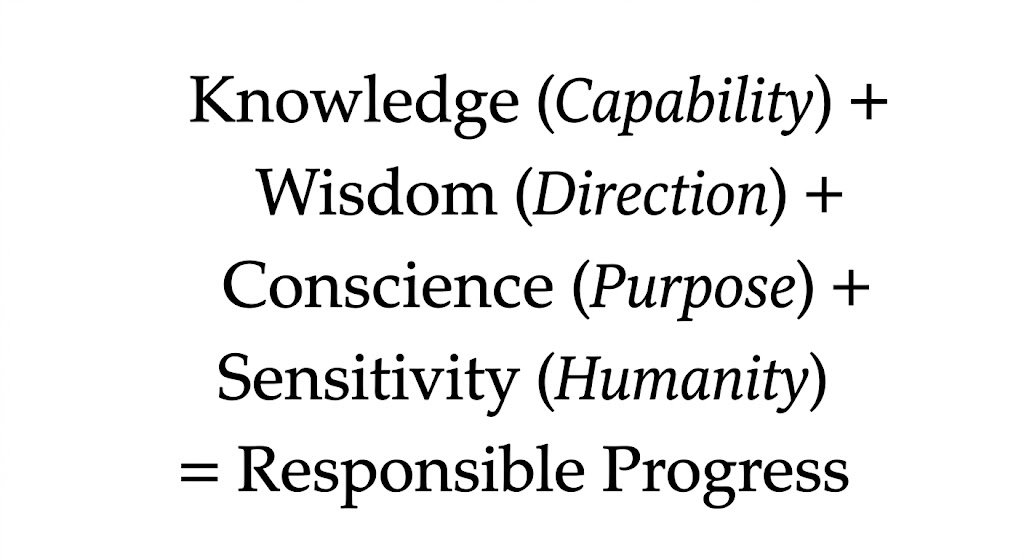
The Essential Question: The challenge of our age is not acquiring more information, but developing the wisdom, discernment, and character required to use it responsibly.